
Professional · Quality and Compliance in Practice Module: Step 2: Traceability and recalls
Recall Management
If unsafe or non-compliant product has left the factory, open Recall Management and Initiate recall. Record the recall type, trigger reason, affected product, batch numbers, quantity and health risk level.
Recall stages
Initiated -> Investigating -> Notifying -> Retrieving -> Completed -> Closed
- Investigating - use Traceability to confirm exactly which batches and customers are affected.
- Notifying - contact customers and, where required, the regulator.
- Retrieving - get product back and quarantine it in the warehouse.
- Completed - all product accounted for.
- Closed - root cause found and an NCR with CAPA is in place.
Speed and accuracy matter more than anything else. A narrow, well-traced recall protects both customers and the business.
Learning objectives
- Initiate a recall with type, trigger, product, batch numbers, quantity, and health risk level
- Investigate with Traceability before you notify
- Close only when the product is accounted for and an NCR with CAPA exists
Walk the screen
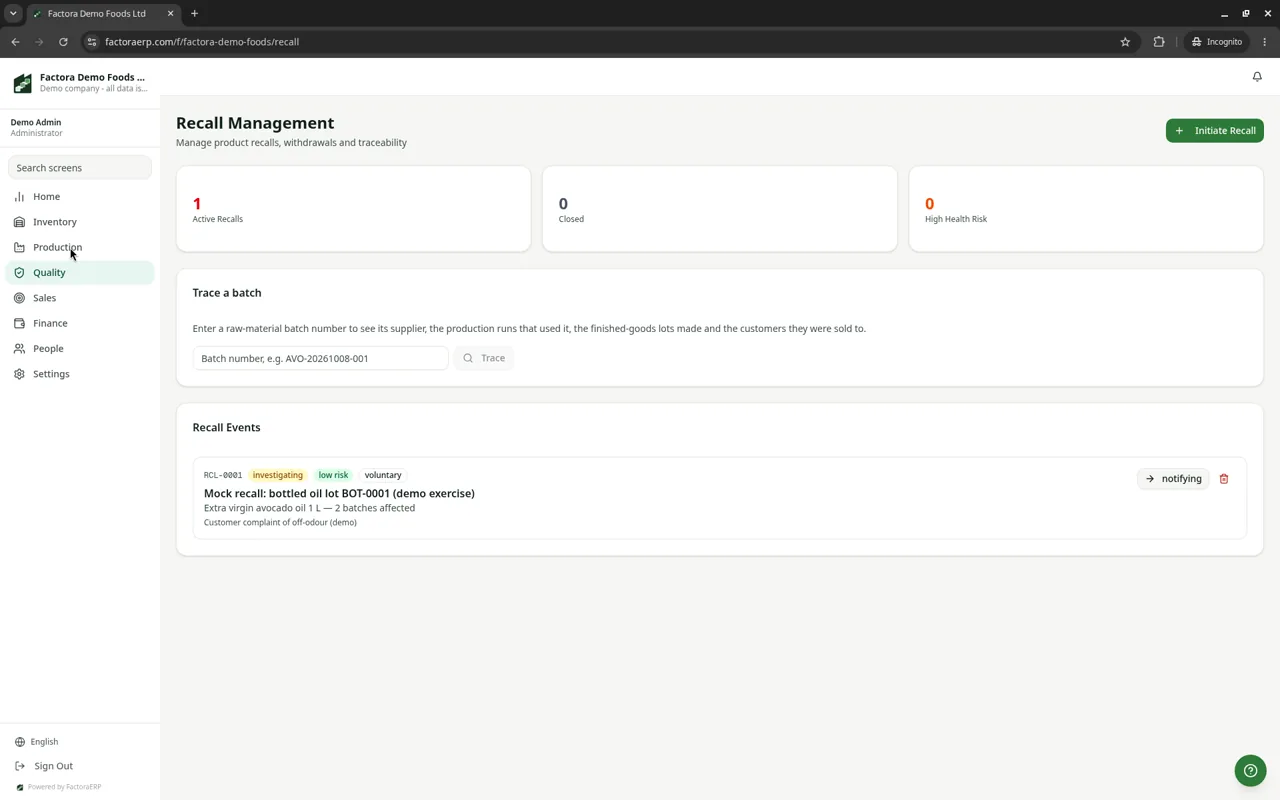
- Open Recall at
/f/<company-slug>/recall. RCL-0001 is already investigating. It is low risk, voluntary, and lists 2 batches. - Record the recall type, the trigger, the affected product, the batch numbers, the quantity, and the health risk level.
- Investigating: use Traceability to confirm batches and customers. Do not notify from memory.
- Notifying: contact those customers and, where required, the regulator.
- Retrieving: get the product back and quarantine it in the warehouse.
- Completed means the product is accounted for. Closed means the root cause is found and an NCR with CAPA is in place.
Worked example
RCL-0001 is investigating, low risk, voluntary, and covers 2 batches. You confirm those batches on Traceability, trace TRC-0001, before you notify. You do not add every customer from last month. Status moves on to Notifying, then Retrieving, only when that step has happened. You do not mark Closed until the NCR's preventive action is verified.
Practical tip: write RCL-0001 and the two batch numbers on the same note. A recall without batch numbers is a rumour.
Common mistakes
- Notifying every customer because it feels safer.
- Closing the recall when the email is sent but the product is still out.
- Starting retrieval before the batch list is confirmed.
Recap
- Initiate with batches, quantity, and health risk level.
- The order is Initiated, Investigating, Notifying, Retrieving, Completed, Closed.
- Closed requires the root cause and a verified CAPA.
Badge
Completing this level is the badge Quality Champion.
Badge on completion: Quality Champion
Quiz for this module: Step 2: Traceability and recalls.