
Professional · Quality and Compliance in Practice Module: Step 1: Inspections and non-conformances
Non-conformance reports
When something does not meet a standard - a failed test, a process not followed, a customer complaint - raise an NCR in Audits & NCR.
A good NCR has:
- A clear title - "Foreign material found in Lot 4471"
- Severity - how serious the risk is to safety, quality or compliance
- What happened, where and when, with evidence
The NCR lifecycle
Open -> Under Investigation -> CAPA In Progress -> Pending Verification -> Closed
CAPA means Corrective and Preventive Action:
- Corrective - fix this problem (quarantine the lot, re-sort it)
- Preventive - stop it happening again (add a sieve, retrain staff, change a supplier)
Root cause - ask "why" five times
The lot had stones. Why? The supplier did not sieve. Why? Their sieve broke. Why? No spare. Why? No maintenance plan. Root cause: supplier has no equipment maintenance plan.
Only close an NCR after verifying the preventive action actually worked.
Learning objectives
- Raise an NCR with a title, severity, and what happened, where, and when
- Separate the corrective action from the preventive action
- Close only after the preventive action is verified, using the five-whys root cause
Walk the screen
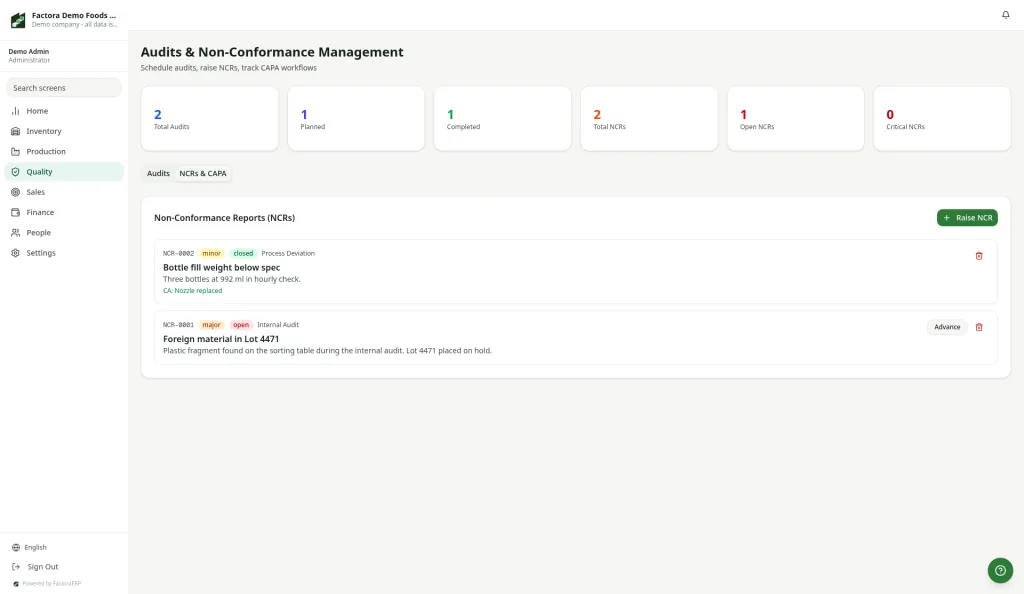
- Open Audits and NCR at
/f/<company-slug>/audits-ncr. NCR-0001 is already open: Foreign material in Lot 4471, severity major. - Title it with the fact, for example foreign material found in Lot 4471. Set severity for safety, quality, or compliance.
- Move the status deliberately: Open, Under Investigation, CAPA In Progress, Pending Verification, Closed.
- Corrective action fixes this lot, such as quarantine or re-sort. Preventive action stops the next one, such as a sieve, retraining, or a supplier change.
- Ask why until the cause is a system gap. Stones in the lot can end at a supplier with no maintenance plan.
- Verify the preventive action worked, then close. Do not close at year end because the list looks old.
Worked example
NCR-0001 is open and major, titled Foreign material in Lot 4471. Corrective action quarantines the lot. Five whys reach a supplier sieve with no spare and no maintenance plan. You do not close NCR-0001 when the lot is quarantined. You close it after the supplier's maintenance plan is checked.
Practical tip: keep the NCR number in the handover. NCR-0001 is easier to find than 'the stones one'.
Recap
- CAPA is corrective and preventive action.
- The path ends at Closed only after verification.
- Root cause is the last why, not the first symptom.
Quiz for this module: Step 1: Inspections and non-conformances.