
Professional · Quality and Compliance in Practice Module: Step 2: Traceability and recalls
Find affected product in minutes, not days.
Traceability
One step back to suppliers, one step forward to customers.
The Traceability screen links lots, production runs and sales. Each trace batch has a trace code, product, supplier and status (Active, On Hold, Recalled, Closed).
Food safety standards expect one step back and one step forward:
- Back - which suppliers and intake lots went into this product?
- Forward - which customers received it?
Practise a mock recall
Pick a finished batch at random each quarter and time how long it takes to list every supplier lot and every customer. The target is under 4 hours. Record the result - auditors ask for it.
Learning objectives
- Open Traceability and read the trace code, product, supplier, and status
- Answer one step back and one step forward for a finished batch
- Time a mock recall against the under-four-hour target and keep the result
Walk the screen
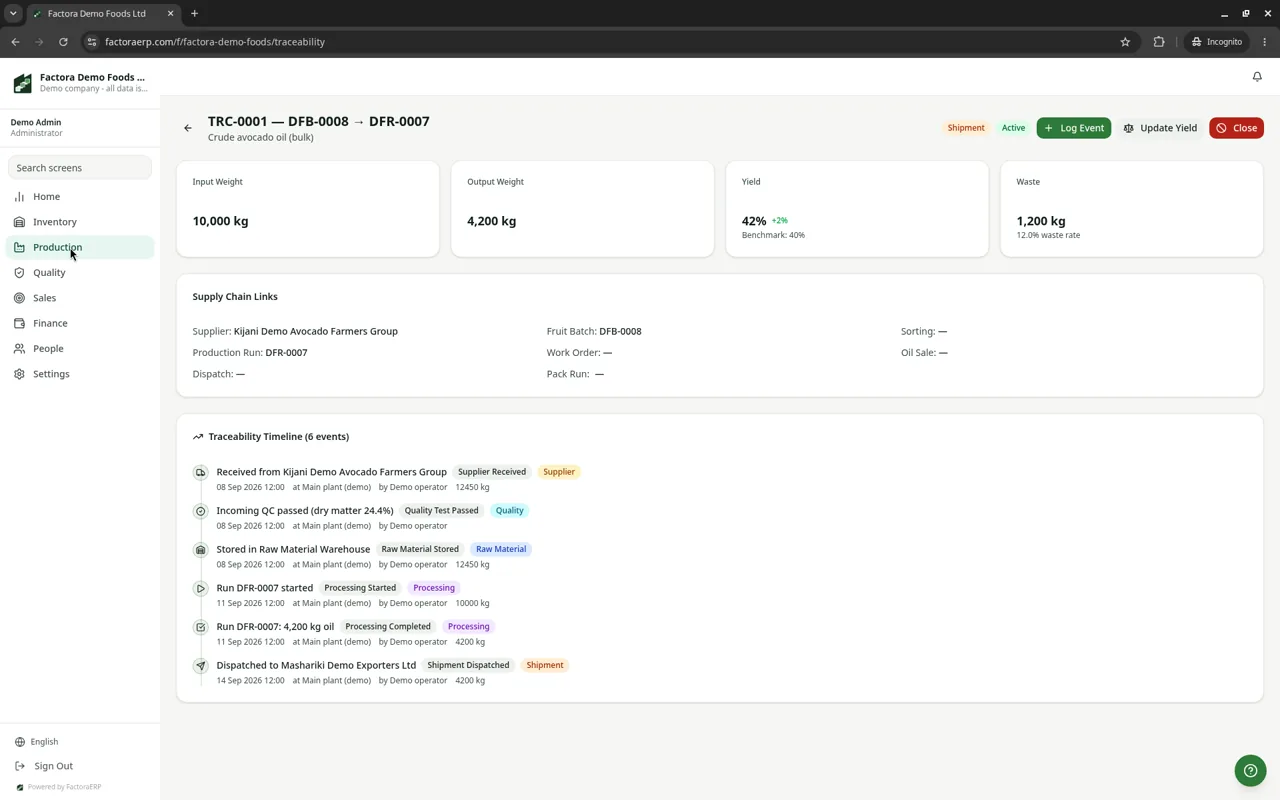
- Open Traceability at
/f/<company-slug>/traceability. Trace TRC-0001 is a six-event timeline from supplier receipt through QC, storage, run DFR-0007, and dispatch. - Step back: list the supplier intake lots that went into it.
- Step forward: list the customers who received it.
- If a lot is On Hold or Recalled, do not dispatch more of it while you are still reading.
- Each quarter, pick a finished batch at random and time the two lists. The target is under 4 hours.
- Write the time down. The record is what an auditor asks to see.
Worked example
You open TRC-0001 and start a clock. The six events run from the supplier receipt through QC, storage, run DFR-0007, and the dispatch. One step back reaches the intake lots, including the 12,200 kg lot when that is the source. One step forward reaches the customers on the dispatch. You write the duration. You do not call it done if the customer list is whoever sales remembers.
Common mistakes
- Tracing only back to the supplier and forgetting the customers.
- Practising the mock recall once and not writing the time.
- Using a batch you already know, every quarter, so the practice is not real.
Recap
- One step back is suppliers and intake lots. One step forward is customers.
- Statuses include Active, On Hold, Recalled, and Closed.
- Mock recalls are timed. The target is under 4 hours.